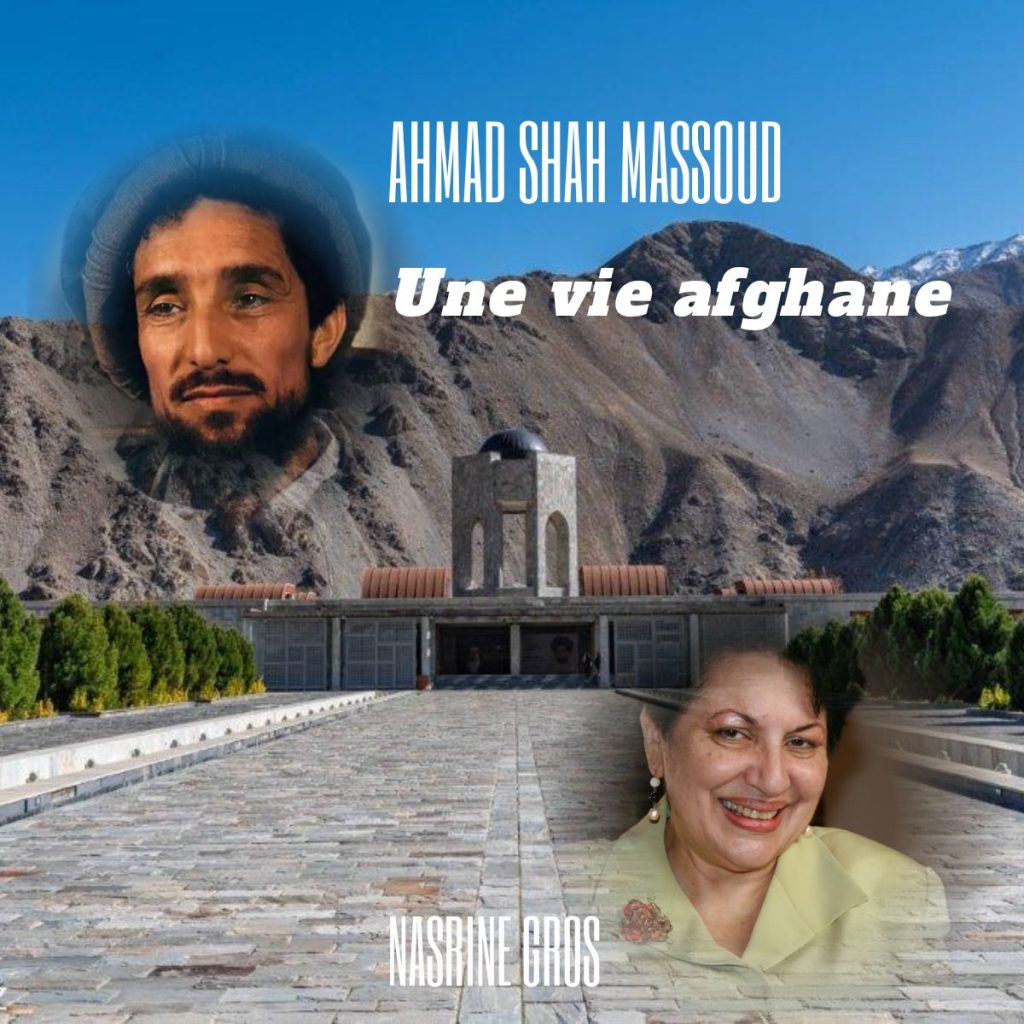
MASSOUD, une vie afghane
Récit des jours qui ont vu et suivi l’assassinat du Commandant Massoud
Par Nasrine Gross
Témoin direct de ces évènements
28 octobre 2001
Je revenais tout juste d’un séjour de cinq semaines en Afghanistan. J’étais à Khoja Bahauddin lorsque le commandant Massoud a été assassiné le 9 septembre, signal d’opérations terroristes aux États-Unis deux jours plus tard. En fait, j’habitais deux portes plus loin des deux terroristes, dans la maison d’hôtes-bureau à côté de la maison d’hôtes nouvellement inaugurée où logeait le commandant Massoud. Ce dimanche-là, vers midi, alors que mon ami américain et moi nous préparions à aller sur la place du village pour acheter des vêtements afghans, depuis le patio commun qui s’étendait sur toute la longueur des chambres d’hôtes, j’ai vu les deux terroristes partir pour « l’interview », leurs appareils photo dans une mallette couleur marron moutarde portée par Abdul, le serveur. Ils étaient accompagnés de Fahim Dashti, le photographe afghan, et d’Assim Suhail, le responsable du ministère des Affaires étrangères responsable des deux bâtiments. Bien sûr, en moins de 30 minutes, le commandant Massoud était mort. Assim Suhail aussi. Dashti et Massoud Khalili, ambassadeur afghan en Inde, furent gravement brûlés et blessés. L’un des terroristes était mort, fendu à la taille par l’explosion à sa ceinture, la partie supérieure du corps partiellement brûlée et collée au mur de la salle de réception. L’autre terroriste dont la première caméra avait filmé le commandant Massoud avait pris sa seconde caméra et était sorti nonchalamment du bâtiment et de la cour, les gardes choqués pensant qu’il filmait encore et ne faisait pas partie du problème. Il était arrivé dans la rue avant d’être arrêté et enfermé dans sa chambre, les gardes restant devant la porte. Il avait grimpé par la petite fenêtre et sauté dans le cimetière adjacent à la maison d’hôtes. De là, il avait couru sur le plateau vers la rivière Panj, à un demi-mile. C’est alors que les autorités réalisèrent qu’il s’était échappé. Deux gardes avec des kalachnikovs et plusieurs autres fonctionnaires, certains pieds nus (les Afghans enlèvent leurs chaussures à l’intérieur), ont couru après lui. Les poursuivants voulaient l’attraper vivant, mais il mesurait plus d’un mètre quatre-vingt-dix et était très fort et a réussi à s’emparer d’un des kalachnikovs. C’est alors que le deuxième kalachnikov a tiré sur lui, la cinquième balle le faisant tomber dans la rivière. Au moment où ils l’ont sorti de l’eau, il était mort.
Quand nous sommes revenus vers 13h30, tout était silencieux. La place et toutes les boutiques, les femmes dans les champs, les porteurs d’eau du village, les filles ramassant du fumier pour le combustible, les hommes allant aux bains publics, les ouvriers construisant le nouvel hôpital, l’appel à la prière des mollahs, tout s’était tu. Je pense que même les bébés avaient cessé de pleurer. Le silence était palpable, comme le soleil qui frappe le Sahara à midi. Comme si la vie avait quitté le village. Comme un visage qui devient vide, tout le paysage, les maisons sur le plateau sec et poussiéreux, les berges de rivières remplies de rizières et de champs de maïs, les vergers plus loin, les camps de réfugiés proches, les montagnes au loin, même le soleil et le ciel, tout semblait désert et abandonné.

Quand on est en état de guerre aussi longtemps que ces gens ont vécu, on développe un sixième sens. Personne n’a dit à ces gens ce qui s’était passé ; ils avaient entendu une explosion et vu un panache de fumée s’échapper du complexe de deux bâtiments à la lisière du village. Leurs oreilles différencient les types d’explosions et de fumées. Ils avaient su instantanément ce qui s’était passé. Mon ami américain et moi ne pouvions pas le dire. Dans le complexe, seul Nasser pleurait doucement et m’a dit qu’Assim avait été tué mais que le commandant Massoud n’était pas blessé (il ne changerait pas son histoire pendant les six jours suivants).
Nous avons attendu tout l’après-midi sous le soleil brûlant et poussiéreux. J’ai demandé à entrer pour prendre des photos à ramener au monde sur les atrocités commises par des étrangers en Afghanistan, mais on m’a dit que la sécurité était toujours occupée à chercher et que j’aurais ma chance plus tard. En fin d’après-midi, un des fourgons arriva avec le cercueil d’Assim, prévu pour être transporté à Panjsher le lendemain matin. Il n’y a pas de morgues, donc le défi était de garder les morts au frais jusqu’au matin. La solution, après beaucoup de discussions, fut de garder le cercueil dans la cour, devant son bureau et nos chambres. Ils durent fouiller pour trouver quelque chose servant de table pour le cercueil et un tissu assez grand pour le recouvrir afin de repousser la poussière, les mouches, les abeilles et les moustiques toujours présents (trop pauvres pour avoir des bureaux et des chaises, les Afghans travaillent désormais principalement sur le sol). Et pour la fraîcheur, ils se sont précipités pour trouver assez d’huile pour le générateur (leur allocation est pour deux heures d’électricité par nuit) et y ont branché leur seul ventilateur électrique, après avoir fabriqué une rallonge improvisée et fabriqué un autre dispositif pour une table assez haute pour que le ventilateur souffle sur le cercueil toute la nuit – – jusqu’au petit matin, quand la chaleur relâche un peu pendant un court moment.
Mon cœur saignait pour une multitude de raisons : pour l’Afghanistan oublié, pour le manque de nécessités de base, pour la malédiction que même la mort n’apporte pas de réconfort, pour l’avenir terriblement prometteur d’Assim écourté, pour une mort aussi tragique ; et pour une vie où chacun doit contribuer pour trouver une table, une couverture, de la nourriture pour tous présents, de la place pour dormir, une sécurité pour tous, des gardes pour éviter une autre catastrophe, prévenir que les talibans n’attaquent pas ; pour s’assurer qu’il y ait assez d’eau, apportée de la rivière dans de grandes cruches sur le dos d’ânes, pour garder les bonbonnes des toilettes pleines (il n’y a pas de toilettes courantes), assez de morceaux de briques de boue cassées servant de papier toilette dans les latrines ; pas de téléphones, radios, voitures… Il n’y avait pas de temps pour pleurer, digérer, même prier, tout le monde était occupé à faire le travail nécessaire dans l’enceinte. Quelle vie que vous ne pouvez pas accorder une seule seconde pour verser une larme sur vos morts ! Ces fonctionnaires, très peu nombreux, faisaient tout le travail joyeusement ; c’était leur devoir de ne pas montrer que le commandant Massoud était aussi mort. Même après leur retour avec le cercueil d’Assim et que j’ai vu que leurs chemises étaient tachées de sang, ils m’ont dit que c’était à cause du lavage du corps d’Assim… En ce jour en Vierge, le mois de naissance du commandant Massoud, comme leurs cœurs devaient ressentir, ceux qui connaissaient la vérité !
Les gens entraient dans le complexe par un ou par deux, les frères d’Assim, d’autres amis combattants, les anciens du village, leurs visages désormais indiscernables alors que le soleil se couchait. Zubair, qui avait terminé les préparatifs pour le cercueil de son patron, vint me voir et me demanda de transmettre aux deux invités non afghans que nous passerions la nuit ailleurs. Sa courtoise explication fut que les amis d’Assim prévoyaient de veiller toute la nuit pour réciter le Coran et qu’il ne voulait pas que notre sommeil soit perturbé. Je savais que c’était une préoccupation encore plus généreuse qui les poussait à nous renvoyer : ils ne savaient pas s’ils allaient être attaqués cette nuit-là et voulaient épargner la vie des trois Occidentaux (Barbara Bick, mon ami juif américain, Roland Bariseel, un Français, et moi, un Afghan-Américain) ! Nous avons pris nos affaires de nuit et avons été conduits en jeep jusqu’à un serai sombre lointain de chambres totalement sombres. Je ne savais pas où nous étions par rapport au village mais on nous a conduits à deux chambres, Roland seul, Barbara et moi dans une pièce d’angle avec des toilettes. Une lanterne à gaz, une cruche et une bassine, du thé vert chaud, une brochette brochette avec du pain, des raisins et une pastèque coupée ont rapidement été amenés par l’aide, un garçon ouzbek de 13 ans. Deux heures plus tard, Zubair et Daud sont arrivés pour s’excuser du désagrément. Je n’ai pas pu retenir mes larmes devant la chaleur de cette hospitalité en un tel moment — comme s’ils n’avaient pas d’autre souci. Ils nous ont assuré qu’un garde serait devant notre porte toute la nuit et que nous retournerions au camp pour le petit-déjeuner.
Ce fut la nuit la plus longue de ma vie. Quand on voit le visage vivant de la terreur, on se méfie de tous les visages, de tous les mouvements, sans savoir qui d’autre pourrait être maléfique, où une autre attaque pourrait arriver et quand. Dans le noir, j’écoutais un autre terroriste rôder dehors en essayant de ne pas bouger pour ne pas réveiller Barbara. Et quand on anticipe le pire, même les petites choses deviennent des sources de peur et d’anxiété. Je fumais et essayais de garder mes cheveux, visage, corps et pieds totalement couverts par le drap qui était ma couverture — une tâche impossible et vraiment dangereuse. Vous voyez, plus tôt, j’avais remarqué le plafond fait de récifs rudimentaires maintenu par des troncs d’arbres plus grossiers, et j’étais sûr que des scorpions et toutes sortes de bestioles tomberaient des fissures d’une construction aussi rustique et primitive. Ce qui me nourrissait, c’était la faible lueur de la lumière à gaz, maintenant dehors avec le garde (Sulayman), qui entrait par une minuscule ouverture d’une fenêtre haute dans le mur et couverte de chardons séchés au lieu de verre. Le chant des coqs, des ânes et des vaches, une sérénade nocturne habituelle autrement agaçante, me réconfortait aussi en me disant que j’étais au milieu du village, entouré d’une population humaine composée de mes propres Afghans.
Pourtant, je n’arrivais pas à chasser de mon esprit l’image des deux terroristes : l’un, grand, avec un visage clair légèrement rond et cheveux bouclés foncés d’Afrique du Nord, vêtu d’un jean kaki et d’une chemise à carreaux bleu et vert à carreaux avec un peu de rouge, peut-être de 28 à 30 ans ; l’autre, un homme plus petit d’environ 35-38 ans, avec un visage plus sombre et ciselé, un long nez haut, des yeux en amande et des cheveux extrêmement raides de quelques teintes plus claires que foncées, épaules larges et musclées, comme un culturiste, portant un pantalon très cher et lisse vert moyen, par-dessus, une chemise taillée en écru foncé à manches longues avec poignets et col ouvert, lançant des regards gênés par-dessus son épaule comme un plouc en tenue dominicale (en fait inquiet pour sa ceinture), ne ressemblant pas du tout à un Nord-Africain mais plutôt à un Yéménite, un Libyen ou un Berbère… Même l’arabe que je les entendais parler différait du dialecte marocain mais je peux me tromper, car mon amie Shoukria Haidar, enseignante d’élèves marocains et algériens en France pendant douze ans, qui a parlé avec eux pendant quarante minutes en français le premier jour de notre arrivée, pensait qu’ils étaient marocains mais trouvait étrange que des Marocains si préoccupés par leur propre pays viennent aussi loin à la recherche d’une simple interview. Dans l’hélicoptère qui avait amené Shoukria, notre amie Françoise et les Arabes de Panjsher, son regard fut attiré par le fait que, dans cette terre chaude et chaude, l’homme plus petit portait un pantalon en velours côtelé très épais. Je réalisai que le grand devait s’inquiéter que quelqu’un parle arabe et ait entendu leurs conversations quand ce matin-là je le vis sortir des toilettes et lui demander en arabe s’il restait assez d’eau. Il a été très surpris et a répondu d’un tout petit mot de deux lettres (fi, signifiant « il y a ») et s’est précipité dans sa chambre, me laissant me demander quel comportement non-arabe et quel journaliste timide !
Le jeudi suivant, Barbara a été transportée à Douchanbé pour prendre son vol vers les États-Unis et moi, sans savoir encore que le commandant Massoud avait été assassiné, à Panjsher pour rejoindre le reste de notre délégation. À Panjsher, Sara Felix, une autre membre de notre équipe américaine d’enquête, m’a tenue dans ses bras pendant cinq minutes entières. Elle a été bouleversée par la nouvelle des terroristes et par l’attentat taliban de la veille, qui était tombé au sommet de la montagne à côté d’elle, désormais notre maison d’hôtes. Le lendemain, avec l’aide de nos hôtes du ministère des Affaires étrangères, nous avons pu renvoyer Sara, Mary MacMakin et les trois autres invités à Douchanbé (où ils sont arrivés six jours plus tard juste à temps pour prendre leur avion pour l’Europe, seule Mary, qui est allée à Faizabad par la route via le col d’Anjoman, est revenue de la moitié du chemin, pour finalement partir en hélicoptère. Son histoire de voyage de Faizabad au Pakistan, l’un des voyages les plus intéressants que j’aie entendus, peut être lue à www.Parsa-Afghanistan.com).
Samedi, l’assassinat du commandant Massoud a été annoncé et les funérailles fixées à dimanche. Comme le veut la coutume afghane, le Dr Nilab Mobarez, une femme afghane vivant en France et maintenant en visite à Panjsher pour inspecter sa clinique, et moi sommes allés chez lui pour présenter nos condoléances à sa femme. À notre retour, j’ai demandé que nous, les femmes de la maison d’hôtes, soyons autorisées à assister aux funérailles, généralement une cérémonie réservée aux hommes. Mon raisonnement était que le commandant Massoud était le premier dirigeant afghan à avoir signé la Déclaration des droits essentiels des femmes afghanes, un document que mon association, NEGAR-Support of Women of Afghanistan, a aidé trois cents femmes afghanes à rédiger et à signer en juin 2000, ainsi qu’un document que nous essayons d’intégrer au processus de paix des Nations Unies afin qu’il parvienne à la prochaine constitution afghane. J’ai dit que je voulais personnellement rendre hommage à cette amie tombée des femmes afghanes. Elles ont accepté et nous étions donc quatre femmes présentes aux funérailles, deux journalistes, Nilab et moi-même.
Tôt le dimanche matin, nous avons été conduits au village de Jangalak, le village ancestral du commandant Massoud. Nous sommes descendus jusqu’à la plaine adjacente à la rivière Panjsher, en face de la maison du commandant Massoud perché sur le flanc de la montagne. En chemin, nous sommes passés devant des écolières sur des balcons, en uniforme, avec des photos du commandant Massoud, des drapeaux ou des fleurs agitées, avec des larmes coulant sur leurs joues ; nous avons entendu et vu des femmes sur les toits, leurs robes colorées flottant dans la brise légère, et des pleurs ; et des groupes d’hommes accablés marchant vers la plaine de toutes parts, certains en tenue militaire, la plupart vêtus de vêtements ordinaires, beaucoup portant le patou (châle) par-dessus leur piran-tunban (chemise et pantalon long du même tissu léger, toujours portés par les villageois afghans mais aujourd’hui, dans leur pauvreté et leur état de villagis, portés aussi par les populations urbaines), beaucoup portant le chapeau pakol que le commandant Massoud a rendu célèbre, d’autres portant le turban classique d’Afghanistan ou sans tête, beaucoup portant de grandes banderoles ou tenant des photos. De belles voix depuis des voitures lentes récitaient de la magnifique poésie de l’Afghanistan ; des patrouilles de sécurité en uniforme guidant doucement la foule. Et tout le long de cette unique route Panjsher, il y avait les carcasses encombrantes, retournées et rouillées d’artillerie soviétique, de chars et de véhicules blindés de transport de troupes, nous rappelant silencieusement mais sans équivoque la plus grande victoire et le partenariat réussi du commandant Massoud avec l’Amérique.
La plaine était très vaste, le long de la berge, avec plusieurs sections, délimitées par des rangées d’arbres. À notre droite se trouvaient tous des militaires. À gauche, elle était bouclée par un treillis plastique, réservé aux dignitaires et à l’hélicoptère chargé d’amener le corps du commandant Massoud. Nous avons été emmenés dans cette zone. Nous avons observé et photographié les célèbres et puissants de l’Afghanistan libre en groupes : le président Rabbani, M. Sayyaf, Haji Qadir, M. Hamoon, le commandant Bismillah Khan, M. Qanooni, le commandant Khoshal Qol, M. Sabawoon, M. Imad… Nous nous sommes précipités pour prendre des photos d’Ahmad, le fils de 12 ans du commandant Massoud, qui est arrivé un peu plus tard. Il était arrivé d’une visite privée du corps de son père. Vêtu d’un costume kaki et marchant d’un pas sérieux, Ahmad fut rapidement encerclé par les médias. Ses manières, son style et sa démarche ressemblent parfaitement à ceux de son père. Ses paroles étaient les plus efficaces. Posé et avec des gestes rappelant ceux de son père, il déclara : « Le meurtre de mon père était injuste et méprisable. Aujourd’hui, le monde sait que sa lutte était juste et que ses paroles étaient vraies. Sa mort prématurée ne mettra pas fin à notre lutte pour un Afghanistan indépendant. Nous continuerons avec plus de ferveur. Je ne me reposerai pas, mais travaillerai à réaliser son rêve. » Son sang-froid et sa connaissance confiante de la situation m’ont fait comprendre ce que cette guerre d’indépendance a fait à chaque homme, femme et enfant vivant cette guerre en Afghanistan. Je me sentais tellement mal préparé et mal à l’aise en comparaison.
Lorsque l’hélicoptère atterrit enfin et que la poussière et le vent se dissipèrent, la foule ne put plus retenir son émotion. À présent, il y avait des milliers d’hommes dans la plaine (le décompte officiel plus tard fut de 24 000) et chacun, gémissant à haute voix comme le tonnerre, se précipita à l’unisson pour tenir le cercueil. Le Dr Abdallah, ministre des Affaires étrangères de l’État islamique d’Afghanistan et ami du commandant Massoud depuis dix-sept ans, qui arriva avec l’hélicoptère, les larmes coulant aussi sur ses joues, les suppliait de se retenir pour ouvrir la porte de l’hélicoptère. Impossible. La foule en pleurs scandait des mots affectueux mêlés de versets du Coran et poussait. Finalement, la sécurité responsable de la plaine atteignit l’hélicoptère ; repoussa la foule et le pilote ouvrit la porte pour sortir ce héros d’Afghanistan et cet être aimé d’entre eux pour son dernier voyage. Le cercueil, drapé du drapeau vert, noir et blanc et des versets du Coran et des fleurs y jetant des fleurs, fut porté jusqu’à la partie la plus large de la plaine, tendrement comme un fils des plus chéris, des milliers de mains se tendant pour le toucher comme si ce simple contact leur donnerait un morceau de lui pour toujours. Devant, M. Qanooni se tenait sur une jeep et, via un haut-parleur, dirigeait la foule émotive et totalement insouciante pour déposer le cercueil devant eux et former de longues rangées pour la prière funéraire. Je restais respectueusement près de la jeep, faisant face à la foule massive et prenant des photos, puis je priai seulement après la prière des hommes. La solennité de la prière, brisée seulement par la ruée du Panjsher, eut un effet apaisant. Mais, encore une fois, tous voulaient porter le cercueil jusqu’à la route et le placer sur le transport blindé destiné à Saricha, le lieu de sépulture désigné. Encore une fois, le Dr Abdullah a réussi à se lever le premier et à diriger les porteurs, des milliers de pieds émotifs courant comme si une inondation noyait la plaine.
Saricha est un sommet où le commandant Massoud tenait son poste de commandement. Il est plusieurs centaines de pieds plus haut que les villages environnants de Khanayz et Tulkha sur la berge. Il se trouve à plusieurs kilomètres de Jangalak et il fallait passer par les villages de Bazarak, Shekhan, Rahman Kheyl, Mullah Kheyl et Laghana — tous en montée. Sa beauté ne réside pas seulement dans la domination de toute la vallée jusqu’à Sangana et jusqu’à Dashtak, avec des vues sur de nombreux villages verdoyants s’élevant des flancs montagneux, et la rivière Panjsher qui serpente à côté. L’horizon immédiat de Saricha au sud-est est les magnifiques sommets de l’Hindu Kouch, avec une majesté inégalée, un lieu approprié : ce qui rend l’Afghanistan éternellement invincible tient désormais dans ses bras l’un des siens, un fils invaincu de l’Afghanistan.
J’étais séparée des autres femmes mais j’ai trouvé la journaliste de la BBC agrippée à un petit tronc d’arbre et hésitante à croiser la foule. Nous nous tenâmes les bras et avons marché sur environ un village jusqu’à ce qu’elle me quitte pour monter la montagne afin d’avoir une vue plus large sur la procession. Je suis restée parmi mon peuple afghan, des milliers d’hommes de tous âges qui, en me voyant dire à ceux devant « laissez passer notre sœur », « prenez sa main pour traverser le fossé », « veillez sur elle pour qu’elle ne glisse pas sur les rochers », « aidez-la à franchir le pont » et bien d’autres salutations chaleureuses. Le dos voûté de chagrin et beaucoup essuyant encore leurs larmes, pas le moment de les aborder dans mes banalités, mais je pouvais deviner à leurs paroles et à leurs visages que j’étais épaule contre épaule avec des Pachtouns, des Hazaras, des Ouzbeks, des Turkmènes, des Noorestanis, des Tadjiks, des Baloutches et… Ce jour-là, le long de la route vers Saricha, et à Saricha, autour du cimetière, toute la mosaïque afghane était une seule couverture humaine unie dans leur chagrin et liée par le souvenir de l’un des leurs.
Le troisième jour du deuil, qui est la « journée des femmes » (appelée aussi la veillée), Nilab et moi sommes allés chez Mme Massoud. La maison est sur un flanc de montagne. L’allée fait le tour d’une haute colline qui cache la maison à la vue. Ensuite, vous entrez par la porte et montez plusieurs escaliers en dalles, chacune menant à une terrasse bordée d’arbres fruitiers, leurs pommes dorées et délicieuses encore vertes et accrochées à leurs branches pour mûrir. Chaque terrasse est un jardin de fleurs colorées plantées en grandes sections, rappelant Paghman, la station estivale de mes jours (37 ans), des pétunias de nombreuses teintes roses et rouges, des phloxes blancs et saumons, de grands asters violets délicats, de grands et petits soucis, des émeutes de pensées et de grands rosiers, à la fois damas et grandiflores. Chaque terrasse possède aussi de petites fontaines et cascades noyant le bruit reculant du Panjsher. La dernière terrasse devient un grand patio qui, à travers une clôture en bois peint en orange, s’ouvre sur la cour intérieure. Puis on voit enfin la maison, une grande structure, trois étages plus haute que la normale, avec sa peinture bleu clair et ses grandes fenêtres blanches différentes des maisons de Panjsher mais encore très proches de ce dont je me souviens des maisons de Paghman. Et pourtant, ce que l’on remarque réellement, c’est la montagne, comme si la maison et ses jardins y étaient collés, proche, colossale et dans sa pierreuse, magnifique.
Nous sommes arrivés vers 11h15 et, en entrant dans la cour intérieure, nous avons été submergés par le bruit des explosions, des avions qui volaient au-dessus et par le chaos de centaines de femmes courant vers le sous-sol. Ahmad se tenait dans la cour, les exhortant à rester calmes et nous a demandé d’entrer dans l’abri alors que les talibans bombardaient la maison et, bien qu’aucune ne soit encore tombée spécifiquement, les femmes étaient paniquées et il voulait qu’elles aillent à l’abri, ce que nous devrions faire aussi. Quand nous avons appris que sa mère était toujours à l’étage dans la salle de deuil officielle, nous avons dit que nous la rejoindrions. Après une demi-heure, les bruits se sont arrêtés. J’ai appris plus tard que les bombes étaient tombées à un kilomètre de là, à Padrukh.
À l’intérieur, Mme Parigul Massoud ne pouvait pas montrer son visage, ses magnifiques yeux verts pleurant et ses joues gonflées, elle portait une grande écharpe blanche épaisse sur elle, couvrant principalement son visage. Elle parla de la nuit la plus dure et la plus solitaire de sa vie, quand elle fut informée de sa mort mais que pour la sécurité personne ne put venir la voir. Elle et sa mère passèrent toute la nuit à pleurer et à réconforter les enfants effrayés et sanglotant. Elle parla de combien il était bien dans le cercueil. Et de ses blessures, de la cicatrice de son cœur qui avait une cicatrice de deux pouces et des milliers de billes rouges sur sa poitrine, mais que la zone du cou était complètement dépourvue de cicatrices, sa peau couleur lune toujours belle ; la cicatrice dans son dos, plus grande, d’environ cinq pouces de long. Son visage était égratigné et ses cheveux et sa barbe étaient un peu brûlés. Elle a dit qu’elle se creusait la tête mais qu’elle n’avait pas trouvé un mot de colère prononcé chez lui pendant toutes leurs années de mariage. Il lui avait dit qu’elle pouvait porter ce qu’elle voulait, de la couleur qu’elle voulait, et gérer la maison comme elle voulait. J’ai demandé et elle m’a donné la permission de prendre des photos de la veillée et d’obtenir des signatures pour notre Déclaration des centaines de femmes venues partager ce moment de chagrin et de tragédie communs. Elle m’a dit « commence tout de suite parce que les gens partent tôt pour rentrer avant la tombée de la nuit. »
Toute la journée, ses cinq filles, âgées de dix à trois ans, en voyant et entendant leur mère pleurer, venaient la voir à chaque fois qu’elle les serrait dans ses bras, les caressait et les disait de sortir avec les invités, sauf qu’elle avait un biberon pour la plus jeune, la nourrissait et la berçait sur ses genoux. Elle nous a dit que son mari était très attaché à la plus jeune et qu’à chaque fois qu’il était rentré, la baignait lui-même, lui embrassait les petits pieds et lui racontait une histoire avant de l’endormir. Elle mentionna qu’il s’intéressait à l’éducation des enfants et qu’il était heureux lorsqu’elle transforma la mosquée détruite de Jangalak en école de village et y envoya les enfants. Il demandait souvent aux enfants ce qu’ils voulaient devenir en grandissant. Une fois, Ahmad avait dit qu’il voulait devenir soldat comme lui et il avait dit « ne le deviens pas parce que sinon tu seras comme moi, loin de chez toi tout le temps, deviendras médecin » ; une autre fois, une fille avait dit vouloir devenir pilote et il avait dit « et tu seras abattu et je perdrai une fille ; deviens enseignant à la place. » Comme ils lui manquaient tous !
Pendant le déjeuner, j’ai demandé à Mme Massoud quels plats son mari préférait. Elle a dit qu’il n’aimait pas les aliments pâteux et qu’il préférait la ‘shorba’ (soupe afghane) mais ne s’est jamais plainte. Elle a dit qu’elle n’avait pas trouvé assez de variété pour se préparer à son emmener sur le front (parfois six mois, une fois par an et le plus souvent plusieurs semaines à trois mois) car il aimait les choses non grasses qui ne se gâtent pas et ne deviennent pas rances. Sur le chemin du retour, à Khoja Bahauddin, j’ai séjourné dans la même maison d’hôtes fatidique et j’ai discuté avec l’un de ses gardes du corps qui était avec lui depuis huit ans et qui surveillait maintenant la salle de réception fermée, qui a mentionné que le commandant Massoud aimait aussi les fruits frais, ses yeux fiers se remplissant de larmes à la pensée de son cher Amer Saheb (cher chef, en dari, le surnom du commandant Massoud dans toute la région). Et je me suis aussi rappelé l’histoire du Dr Abdullah, comment un jour, sur un coup de tête, ils étaient partis faire de l’escalade et le commandant Massoud avait emporté une pomme avec lui. En montant, il avait accéléré et le Dr Abdullah était loin derrière. Mais en essayant de rattraper son retard, fatigué et assoiffé, il tomba sur la moitié d’une pomme, coincée dans la fissure d’une pierre avec le canif du commandant Massoud, qui l’attendait.
La salle de deuil officielle était le salon, en forme de L et grand, avec un mur pour la télévision et les cassettes vidéo, parmi lesquelles Mission Impossible, Gandhi, Le Tireur d’élite et les arts martiaux. À l’étage, je rendis visite à quelques hommes de la famille dans un petit bureau rempli d’étagères. Juste au-dessus du salon, et presque aussi grande, se trouvait la bibliothèque du commandant Massoud, la seule pièce de la maison à avoir des meubles au lieu des nattes utilisées pour s’asseoir. On sait qu’il aimait lire et qu’il aimait écrire. En fait, la nuit précédant son assassinat, il resta éveillé très tard à lire de la poésie avec Massoud Khalili ; et il tenait un journal pendant plus de 20 ans, écrivant chaque nuit.
Deux murs de la bibliothèque sont couverts d’étagères continues, un troisième, des étagères et une fenêtre. Le quatrième mur est composé de fenêtres donnant sur la vallée et le Panjsher. Son bureau, toujours avec des stylos et des carnets, dans le coin de ces deux murs de fenêtres, contemple le panorama, cette symphonie afghane de montagne, rivière et campagne, éternelle, immaculée et inchangée. Sur le côté du bureau, se dresse une grande bibliothèque qui ne contient que des dictionnaires, des très petits aux plus grands (je n’avais jamais vu de dictionnaires dari aussi grands auparavant). Sur les autres étagères, j’ai repéré les œuvres traduites d’Ibn Khaldun, de nombreux livres d’Ali Shariati, de nombreux exemplaires du Coran et des textes sur l’islam, des étagères pleines de recueils de poésie, de nombreux livres sur la politique et les relations diplomatiques, de nombreux ouvrages sur l’histoire des pays, en particulier des voisins de l’Afghanistan, Kalilah Damna, des traductions d’ouvrages de Freud et Sartre, des ouvrages de philosophie, des livres en arabe. J’ai été surpris de ne pas trouver grand-chose sur l’armée, la guerre, ni sur des biographies célèbres ou des livres écrits par des Afghans. Il manquait aussi des images, tableaux et autres ornements sur les murs ; il manquait complètement ses propres souvenirs. À l’exception des étagères à dictionnaires, les autres étagères n’étaient pas pleines à ras bord, mais plutôt comme un travail en cours. Il n’a peut-être pas eu le temps d’ouvrir toutes ses boîtes de livres, car j’ai appris plus tard que le commandant Massoud n’avait vécu dans la maison que vingt jours avant d’être assassiné (sa femme a aussi déploré que, pour la première fois de leur vie, ils aient leur propre maison et de ce qu’elle en ferait maintenant qu’il n’était plus là). Il l’avait apparemment conçue lui-même, son premier amour étant l’architecture, il avait choisi les couleurs de peinture et avait même installé la fine moquette bon marché si courante à Panjsher lui-même (il avait dû emprunter le couteau à découper à un parent et, en le revenant, il s’était vanté qu’il pourrait avoir un avenir comme poseur de tapis) !
Je me suis assis à son bureau pour mieux ressentir et j’ai réalisé que c’était un bureau pour écrire. Je me suis assis sur le canapé-lit devant les fenêtres et j’ai réalisé que c’était là qu’il avait dû lire (c’est aussi là que le Dr Abdullah dormait lors de sa visite). J’ai pensé à tous les livres écrits à son sujet, à toutes les photos prises de lui, à ses exploits, victoires, épreuves et erreurs, à lui en tant que leader politique, en tant que génie militaire, en tant que mari, père, ami, à toute sa vie si importante pour l’Afghanistan et le monde. Et j’ai pensé à quel point il serait merveilleux d’avoir une bibliothèque construite en son nom. Il avait construit sa propre maison et bibliothèque de ses rêves. Ce serait une merveilleuse affirmation de notre vie afghane s’il existait aussi une bibliothèque nationale pour lui, ce combattant de la liberté afghan qui a construit de sa vie l’histoire de notre époque.
P.S. : J’ai reconstitué la séquence des événements de 12h20 à 13h30 le 9 septembre, c’est-à-dire pendant et immédiatement après l’assassinat, en me basant sur ce que j’ai entendu de plusieurs personnes, afghanes et non-afghanes, à Khoja Bahauddin et Panjsher, ainsi que sur les déclarations de Dashti et Khalili dans la presse. Cependant, je n’ai jamais demandé de compte rendu officiel.
Nasrine Gross, une écrivaine afghano-américaine, était la représentante à Washington de Negar-Support of Women of Afghanistan. Parmi ses livres figurent « Qassarikh-e Malalay : Souvenirs du premier lycée de filles en Afghanistan », « Étapes de la paix et notre responsabilité en tant qu’Afghans » et « Femmes dans le Coran : Versets du Coran traduits du farsi ». Son e-mail est kabultec@gmail.com, son site web www.kabultec.org
MASSOUD: AN AFGHAN LIFE
By Nasrine Gross
October 28, 2001
I have just returned from a five-week stay in Afghanistan. I was in Khoja Bahauddin when Commander Massoud was assassinated on September 9, the signal for terrorist operations in the US two days later. In fact, I lived two doors down from the two terrorists, in the guesthouse-cum-office next to the newly inaugurated guesthouse where Commander Massoud was staying. That Sunday, around 12:00 noon, as my American friend and I were getting ready to go to the village square to buy Afghan clothes, from the common patio that ran the length of the guesthouse rooms I watched the two terrorists go for the ‘interview’, their camera(s) in a brown-mustard color briefcase carried by Abdul, the waiter. They were accompanied by Fahim Dashti, the Afghan photographer, and Assim Suhail, the official of the ministry of Foreign Affairs in charge of both buildings. Of course, within 30 minutes, Commander Massoud was dead. So was Assim Suhail. Dashti and Massoud Khalili, the Afghan Ambassador to India were badly burned and injured. One of the terrorists was dead, split from the waist by the explosion in his belt, top part of his body partly burnt and stuck to the wall of the reception hall. The other terrorist whose first camera had shot Commander Massoud had taken his second camera and non-chalantly had walked out of the building and the courtyard, the shocked guards thinking he was still filming and was not part of the problem. He had reached the street before he was caught and locked in his room, guards staying outside the door. He had climbed the little window and jumped into the cemetery adjacent to the guesthouse. From there he had ran down the plateau towards the Panj River, a fifth of a mile away. That is when officials realized he had gotten away. Two guards with kalashnikovs and several other officials, some of them barefoot (Afghans take off their shoes when they are inside) ran after him. The pursuers wanted to catch him alive, but he was more than six feet tall and very strong and was able to snatch one of the kalashnikovs. That is when the second kalashnikov fired on him, the fifth bullet dropping him in the river. By the time they took him out of the water, he was dead.
When we returned around 1:30 p.m., all was silent. The square and all the shops, the women in the fields, the village water carriers, the girls picking up dung for fuel, the men going to the public bath, the workers erecting the new hospital, the mullahs’ call to prayer, all had fallen silent. I think even the babies had stopped crying. The silence was palpable, like the sun pounding on the Sahara at noon. As if life had deserted the village. Like a face turning blank, the entire scenery, the homes on the dry dusty plateau, the riverbanks full of rice paddies and corn fields, the fruit orchards further out, the refugee camps nearby, the mountains in the distance, even the sun and the sky, all felt desolate and abandoned.
When you are in a state of war for as long as these people have lived you develop a sixth sense. Nobody told these people what had happened; they had heard an explosion and seen a plume of smoke coming from the two-building compound at the edge of the village. Their ears differentiate between the types of explosions and smokes. They had known instantaneously what had occurred. My American friend and I could not tell. In the compound, only Nasser was softly crying and told me that Assim was killed but that Commander Massoud was not hurt (He would not change his story for the next six days).
We waited all afternoon in the hot dusty sun. I asked to go in and take pictures to bring back to the world about the atrocities outsiders are committing in Afghanistan but was told that security was still busy searching and I would get my chance later. By late afternoon, one of the vans came bringing Assim’s coffin, scheduled to be flown to Panjsher the next morning. There are no morgues and so the challenge was how to keep the dead cool until morning. The solution after much discussion was to keep the coffin in the courtyard, in front of his office and our rooms. They had to scrounge around to find something to serve as a table for the coffin and a cloth large enough to serve as a covering over it to keep away the ever-present dust, flies, bees and mosquitoes (too poor to have desks and chairs Afghans now mostly work, eat, sleep and visit on the floor). And for coolness, they scrambled to find enough oil for the generator (their allotment is for two hours of electricity per night) and hooked their only electric fan to it, after creating a makeshift extension cord and making another contraption for a table high enough for the fan to blow over the coffin for the duration of the night – – until around early morning, when the heat lets up a bit for a short spell.
My heart was bleeding for a myriad of reasons: For the forgotten Afghanistan, for the lack of basic necessities, for the curse that even death does not bring comfort, for Assim’s terrifically-promising future cut short, for such a tragic death; and for a life where everyone has to pitch in to find a table, a covering, food for all present, room for all to sleep in, security for all to be safe, guards to prevent another disaster, alert that the Taliban don’t attack; for insuring that there is enough water, brought from the river in big pitchers on the back of donkeys, to keep the canisters in the washroom full (there are no bathrooms with running water), enough broken mud-brick pieces that serve as toilet paper in the latrine; for no telephones, radios, cars… There was no time to mourn, digest, even pray, everyone was busy doing the work that was needed to be done in the compound. What a life that you cannot spare one moment to shed a tear over your dead! These officials, very few in number, were doing all the work cheerfully; that was their duty not to show that Commander Massoud was also dead. Even after they returned with Assim’s coffin and I could see that their shirts were bloodstained, they told me it was from washing Assim’s body… On this day in Virgo, the month of Commander Massoud’s birth, how their hearts must have felt, those who knew the truth!
People were coming into the compound in ones and twos, Assim’s brothers, other fighter friends, village elders, their faces now indistinguishable as the sun was going down. Zubair who had finished the arrangements for his boss’s coffin, came to me and asked me to convey to the two non-Afghan guests that we would be spending the night elsewhere. His gracious explanation was that Assim’s friends were planning to hold an all-night vigil of reciting the Koran and he did not want our sleep to be disrupted. I knew that it was really an even more gracious concern that was pushing them to send us away: They did not know if they were going to be attacked that night and wanted to spare the lives of the three westerners (Barbara Bick, my Jewish American friend, Roland Bariseel, a Frenchman, and me, an Afghan American)! We took our night stuff and were driven in a jeep to a far away dark serai of totally dark rooms. I could not tell where in relation to the village we were but we were shown to two rooms, Roland by himself and Barbara and I in a corner room that boasted a washroom inside. A gas lantern, water pitcher and basin, hot green tea, skewered kabob with bread, grapes and cut up watermelon were quickly brought in by the help, an Uzbek boy of 13. Two hours later Zubair and Daud showed up to apologize for the inconvenience. I could not hold my tears at the warmth of this hospitality during such a time – – as if they had no other worry. They assured us that a guard would be outside our door all night long and that we would go back to the compound for breakfast.
That was the longest night of my life. When you see the living face of terror, you become weary of all faces, all movement, not knowing who else might also be evil, where else another attack might come and when. In the dark I kept listening for another terrorist lurking outside while trying not to move so as not to wake up Barbara. And when you are anticipating the worst, even little things become sources of further fear and anxiety. I was smoking and trying to keep my hair, face, body and feet totally covered with the sheet that was my cover — an impossible and really hazardous task. You see, earlier, I had noticed the ceiling made of crude reefs held by cruder tree trunks across, and was sure that scorpions and all sorts of crawlies would fall from the cracks of such a rustic and primitive construct. What gave me sustenance was the dim glow of the gas light, now outside with the guard (Sulayman), coming through a tiny opening of a window high in the wall and covered with dried thistle instead of glass. The sound of roosters, donkeys and cows singing, an otherwise annoying regular nightly serenade, also comforted me that I was in the middle of the village surrounded by a human population of my own Afghans.
Still, I could not shake from my mind the image of the two terrorists: One, tall, with a light-colored slightly plump face and curly dark hair of North Africa, wearing khaki jeans and plaid blue and green shirt checkered with some red, maybe 28 to 30 years old; the other, a shorter man of about 35-38 years old, with a darker chiseled face, long high nose, almond eyes and extremely straight hair of a couple of shades lighter than dark with wide shoulders and muscles like a body-builder’s, wearing very expensive and slick pants of medium dark green and over them, a tailored shirt of dark ecru with long sleeves with cuffs and open collar, throwing self-conscious glances over his shoulder like a country bumpkin in his Sunday best (actually worried about that belt of his), not looking at all like a North African but rather more like a Yemeni or a Libyan or a Berber… Even the Arabic I heard them speak was different from Moroccan dialect but I could be wrong as my friend Shoukria Haidar, a teacher of Moroccan and Algerian students in France for twelve years, who spoke with them for forty minutes in French on our first day of arrival thought they were Moroccan but found it odd that Moroccans who are so preoccupied with their own country would come this far in search of just an interview. In the helicopter that had brought Shoukria, our friend Francoise and the Arabs from Panjsher, her eye was caught by the fact that in this hot hot land the shorter man was wearing very thick corduroy pants. I realized that the tall one must have become worried that someone spoke Arabic and had heard their conversations when that morning I saw him come out of the washroom and asked him in Arabic if there was enough water left. He was very taken aback and answered with one tiny word of two-letters (fi, meaning ‘there is’) and bolted into his room, leaving me thinking what non-Arab behavior and what a shy journalist!
On the following Thursday, Barbara was flown to Dushanbe to catch her flight to the US and me, still not knowing Commander Massoud had been assassinated, to Panjsher to join the rest of our delegation. In Panjsher, Sara Felix, another member of our American fact-finding team, on seeing me held me in her arms for five full minutes. She was shaken by the news of the terrorists and by the Taliban bombing the day before that had fallen on top of the mountain beside her, now our, guesthouse. The next day, with the help of our hosts from the ministry of Foreign Affairs we were able to send back Sara, Mary MacMakin and the other three guests to Dushanbe (where they arrived six days later just in time to catch their plane to Europe, only Mary who went to Faizabad by road through the Anjoman Pass returned from half-way, to finally go by helicopter. Her story of going from Faizabad to Pakistan, one of the most interesting journeys I have heard can be read at www.Parsa-Afghanistan.com).
On Saturday Commander Massoud’s assassination was announced and the funeral set for Sunday. As is the Afghan custom, Dr Nilab Mobarez, an Afghan woman living in France and now visiting Panjsher to inspect her clinic, and I went to his house to extend our condolences to his wife. On our return I asked that we, the women at the guesthouse be allowed to attend the funeral, normally a men-only ceremony. My reasoning was that Commander Massoud was the first Afghan leader to have signed the Declaration of the Essential Rights of Afghan Women, a document my association, NEGAR-Support of Women of Afghanistan helped three hundred Afghan women draft and sign in June of 2000 and a document which we are trying to make part of the peace process in the United Nations so it gets to the next constitution of Afghanistan. I said I wanted to personally pay my respect to this fallen friend of Afghan women. They accepted and so we were four women who attended the funeral, two journalists, Nilab and myself.
Early Sunday morning, we were driven to the village of Jangalak, Commander Massoud’s ancestral village. We walked down to the plain adjacent to the Panjsher River across from Commander Massoud’s house perched on the side of the mountain. On our way we drove by school girls on balconies, with their uniform on, with pictures of Commander Massoud or flags or flowers waving and with tears flowing down their cheeks; we heard and saw women on rooftops, their colorful dresses aflutter in the small breeze, and wailing; and groups of grief-stricken men walking towards the plain from every direction, some in military garb, most dressed in everyday clothes, many wearing the patou (shawl) over their piran-tunban (shirt and long pants of the same light material, always worn by Afghan villagers but now, in their poverty and villagized state, worn by urban populations as well), many wearing the pakol hat that Commander Massoud made famous, others wearing the regular turban of Afghanistan or bare-headed, many carrying large banners or holding pictures. Beautiful voices from slow moving cars were reciting glorious poetry of Afghanistan; uniformed security patrols gently guiding the multitude. And all along this sole Panjsher road, there were the bulky, upturned and rusted carcasses of Soviet artillery, tanks and armored personnel carriers, silently but unmistakably reminding us of Commander Massoud’s greatest victory and successful partnership with America.
The plain area was very large, along the riverbank, with several sections to it, defined by rows of trees. To the right of us were all military people. To the left it was cordoned off by plastic mesh, reserved for the dignitaries and for the helicopter that was to bring Commander Massoud’s body. We were taken to this area. We watched and photographed the famous and mighty of the free Afghanistan as they came in groups: President Rabbani, Mr. Sayyaf, Haji Qadir, Mr. Hamoon, Commander Bismillah Khan, Mr. Qanooni, Commander Khoshal Qol, Mr. Sabawoon, Mr. Imad… We scrambled to get pictures of Ahmad, Commander Massoud’s 12-year old son, who came a little later. He had arrived from a private viewing of his father’s body. Dressed in a khaki suit and walking with serious steps, Ahmad was quickly surrounded by the media. His mannerisms, style and gait are completely like his father’s. His words were the most effective. Composed and with gestures reminiscent of his dad’s, he said, « my father’s killing was unjust and despicable. Now the world knows that his struggle was just and his words true. His untimely death will not cut short our fight for an independent Afghanistan. We will continue with more fervor. I will not rest but work to realize his dream. » His composure and his confident knowledge of the situation made me understand what this war of independence has done to every man, woman and child living this war inside Afghanistan. I felt so unprepared and awkward by comparison.
When the helicopter finally landed and the dust and wind subsided the crowd could no longer keep back its emotion. By now there were thousands of men in the plain area (the official count later was 24,000) and everyone to a man, moaning aloud like thunder, rushed in unison to hold the coffin. Dr. Abdullah, the Foreign Minister of the Islamic State of Afghanistan and Commander Massoud’s friend for seventeen years, who came with the copter, tears streaming down his cheeks too, kept begging them to hold back so the helicopter door could be opened. No way. The weeping multitude was chanting endearments mixed with verses of the Koran and was pushing. Finally, the security in charge of the plain reached the copter; pushed the crowd aside and the pilot opened the door to bring out this hero of Afghanistan and this beloved of all of them for his final journey. The coffin draped in the green, black and white flag and verses of the Koran and people throwing flowers on it was carried to the widest part of the plain, tenderly like a most cherished son, thousands of hands reaching to touch it once as if that one touch would give them a piece of him forever. In front, Mr. Qanooni was standing on a jeep and through a loudspeaker directing the emotional and totally heedless crowd to set the coffin before them and form long rows for the funeral prayer. I respectfully kept near the jeep, facing the massive crowd and taking pictures, and approached the coffin and prayed only after the men’s prayer had finished. The solemnity of the prayer, broken only by the rush of the Panjsher, had a calming effect. But, again all wanted to carry the coffin to the road and place it on the armored personnel carrier that was to take it to Saricha, the designated gravesite. Again Dr. Abdullah managed to get up first and direct the pallbearers, thousands of emotional feet rushing as if a flood was drowning the plain.
Saricha is a mountaintop where Commander Massoud kept his command post. It is several hundred feet higher than the surrounding villages of Khanayz and Tulkha on the riverbank. It is several kilometers from Jangalak and you had to pass the villages of Bazarak, Shekhan, Rahman Kheyl, Mullah Kheyl and Laghana – – all uphill. Its beauty lies not only on its command of the entire valley up to Sangana and down to Dashtak, with vistas of many lush green villages jutting out of the mountainsides, and the rushing Panjsher River winding past it. Saricha’s immediate horizon to the southeast is the magnificent peaks of the Hindu Kush with stark majesty unparalleled, a fitting place: That which makes Afghanistan eternally unconquerable is now holding in its arms one of its own, an undefeated son of Afghanistan.
I was separated from the other women but found the BBC reporter clutching at a small tree trunk and hesitant to pass the throngs. We held arms and we walked for about one village until she left me to get up the mountainside to get a larger view of the procession. I remained among my Afghan people, thousands of men of all ages who upon noticing me would tell those in front ‘let our sister pass’, ‘take her hand to cross the ditch’, ‘watch for her that she doesn’t slip over the rocks’, ‘help her go over the bridge’ and many other warm acknowledgements. With their backs hunched in sorrow and many still wiping their tears, not the moment to engage them in my banalities, but I could tell by their words and their faces that I was shoulder to shoulder with Pashtuns and Hazaras and Uzbeks and Turkmens and Noorestanis and Tajiks and Baluchis and… That day, along the road to Saricha, and at Saricha, around the gravesite, the whole of Afghan mosaic was a single human quilt unified in their grief and bonded by the memory of one of their own.
On the third day of the mourning which is the « women’s day » (also called the wake), Nilab and I went to Mrs. Massoud’s. The house is on a mountainside. The driveway is around a high hill hiding the house from the view. Then you enter the gate and go up several sets of flagstone steps, each reaching a terrace and each lined with fruit trees, their golden delicious apples still green and hanging onto their branches to ripen. Each terrace is a garden of many colored flowers planted in large sections, reminiscent of Paghman, the summer resort of my days (37 years ago), petunias of many pink and red hues, phloxes of white and salmon, tall asters of delicate purple, large and small marigolds, riots of pansies and grand rose bushes both damask and grandiflora. Each terrace also has small fountains and waterfalls drowning the receding sound of the Panjsher. The last terrace turns into a large patio that through an orange painted wooden fence opens into the inner courtyard. Then you finally see the house, a large structure, its three stories taller than normal, and with its light blue paint and large white windows unlike the houses of Panjsher but again much like what I remember of Paghman’s homes. And yet, what you actually notice is the mountain, as if the house and its gardens are pasted on it, close, colossal and in its stony barrenness, beautiful.
We arrived around 11:15 a.m. and as we walked into the inner courtyard were engulfed by sound of explosions, airplanes flying overhead and by pandemonium of hundreds of women running to the basement. Ahmad was standing in the courtyard urging them to be calm and asked us to enter the shelter as the Taliban were bombing the house and although as yet none had fallen on the house specifically, the women were panicky and he wanted them to go to the shelter and we should too. When we found out that his mother was still upstairs in the formal mourning room, we said we would join her. After a half-hour the sounds stopped. I later learned that the bombs had fallen a kilometer away, in Padrukh.
Inside, Mrs. Parigul Massoud could not show her face, her beautiful green eyes shot from crying and her cheeks swollen, she kept a large thick white scarf over her, mostly covering her face. She talked about the hardest and loneliest night of her life, when she was informed about his death but due to security no one could come to see her. She and her mom spent the whole night crying and comforting the scared and sobbing children. She talked about how good he looked in the coffin. And about his wounds, how his heart area had a two inch scar and scattered around it thousands of red pellets on his chest, but that his neck area was completely void of scars, his moon-colored skin still beautiful; the scar in his back, larger, about five inches long. His face had scratches and his hair and beard were a little scorched. She said she was wracking her brain but found not one angry word uttered by him at home in all the years they were married. He had told her she could wear whatever she wanted in whatever color she wanted and run the house however she preferred. I asked and she gave me permission to take pictures of the wake and get signatures for our Declaration from the hundreds of women that had also come to share this moment of common grief and tragedy. She told me ‘start right away because people leave early to get home before dark.’
All through the day, her five daughters, ages ten to three, on seeing and hearing their mother cry, would come to her every other moment and she would hug and caress them and tell them to go out and be with the guests, only she had a bottle for the youngest, and she would feed her and rock her to sleep in her lap. She told us that her husband was very fond of the youngest and whenever home would bathe her himself, kiss her tiny feet and tell her a story before putting her to sleep. She mentioned that he was interested in the children’s education and was happy when she renovated the destroyed mosque of Jangalak into a village school and sent the kids there. He often asked the children what they wanted to become when they grew up. One time, Ahmad had said he wanted to be a soldier like him and he had said « don’t become one because then you will be like me, away from home all the time, become a medical doctor; » another time a daughter had said she wanted to become a pilot and he had said « and you will be shot down and I will lose a daughter; become a teacher instead. » How they all missed him!
During lunch I asked Mrs. Massoud what dishes her husband had liked best. She said he did not like doughy foods and was partial to ‘shorba’ (Afghan soup) but never complained. She said that she could not find enough variety to prepare for him to take to the fronts (sometimes as long as six months, once a whole year and most often several weeks to three months) as he liked non-fatty things that didn’t spoil or get rancid. On my way back, in Khoja Bahauddin, I stayed in the same fateful guesthouse and had a conversation with one of his bodyguards that had been with him for eight years and now kept watch over the closed reception hall, who mentioned that Commander Massoud also liked fresh fruit, his proud eyes filling up with tears at the thought of his cherished Amer Saheb (dear chief, in Dari, Commander Massoud’s nickname throughout the area). And I remembered Dr. Abdullah’s story too, of how one day, on the spur of the moment, the two of them had gone mountain climbing and Commander Massoud had taken an apple with him. On the way up he had gone faster and Dr. Abdullah was way behind. But on trying to catch up, tired and thirsty, he had come upon half of an apple, stuck on the crack of a stone with Commander Massoud’s penknife, waiting for him.
The official mourning room was the living room, L-shaped and large with a wall for TV and videocassettes, among them, Mission Impossible, Gandhi, The Sniper and Martial Arts. Upstairs, I visited some men of the family in a small office full of shelves. Right above the living room and almost as large, was Commander Massoud’s library, the only room of the house that had furniture instead of the mats used for sitting. He is known to have loved to read and was fond of writing. In fact, the night before his assassination he stayed up very late reading poetry with Massoud Khalili; and he kept a diary for over 20 years, writing every night.
Two walls of the library have continuous shelves, a third, shelves and a window. The fourth wall is all windows overlooking the valley and the Panjsher. His desk, still with pens and note pads on it, in the corner of these two window walls, takes in the panorama, this Afghan symphony of mountain, river and countryside, forever enduring, pristine and unchanged. On the side of the desk, stands a large bookshelf that only has dictionaries, from very small sizes to the largest (I had never seen such large Dari dictionaries before). On the other shelves, I spotted the translated works of Ibn Khaldun, many books by Ali Shariati, many copies of the Koran and texts on Islam, shelves full of poetry books, many many books on politics and diplomatic relations, many works about history of countries, especially neighbors of Afghanistan, Kalilah Damna, translations of works by Freud and Sartre, tomes on philosophy, books in Arabic. I was surprised that I did not find a lot about military or warfare or famous biographies or books written by Afghans. Also missing were pictures, tableaus and other ornaments on the walls; completely missing were his own mementos. Except for the dictionaries shelf the other shelves were not full to the brim, rather more like a work in progress. He may not have had time to open all his book cartons as I later learned that Commander Massoud had lived in the house for only twenty days before he was assassinated (his wife also lamented that for the first time in their life they had a house of their own and what she would do with it now that he was gone). He had apparently designed it himself, his first love being architecture, he had selected the paint colors and he had even installed the thin cheap carpeting so common in Panjsher himself (he had to borrow the cutting knife from a relative and upon returning it had boasted that he might have a future as a carpet installer)!
I sat at his desk to get a better feel and realized it was a desk for writing. I sat at the sofabed in front of the windows and realized that is where he must have read (that is also where Dr. Abdullah slept when he was visiting). I thought of all the books written about him, all the pictures taken of him, of his exploits, victories, trials, and mistakes, of him as a political leader, as a military genius, of him as a husband, a father, a friend, of the span of his life so important for Afghanistan and the world. And I thought how wonderful it would be to have a library built in his name. He had built his own dream house and library. It will be a marvelous affirmation of our Afghan life if there is also a national library for him, this freedom fighter of Afghanistan who built with his life the history of our times.
P.S.: I have reconstructed the sequence of events from 12:20 p.m. to 1:30 p.m. of September 9, i.e., during and immediately after the assassination, based on what I heard from several people, both Afghan and non-Afghan in Khoja Bahauddin and Panjsher, and Dashti and Khalili’s pronouncements in the press. However, I never asked for an official account.
Nasrine Gross, an Afghan American writer was the Washington representative of Negar-Support of Women of Afghanistan. Among her books are « Qassarikh-e Malalay: Memories of the First Girls’ High School in Afghanistan », « Steps of Peace and our Responsibility as Afghans » and “Women in the Koran: Verses of the Koran in Translation of Farsi”. Her email is kabultec@gmail.com, her web site www.kabultec.org