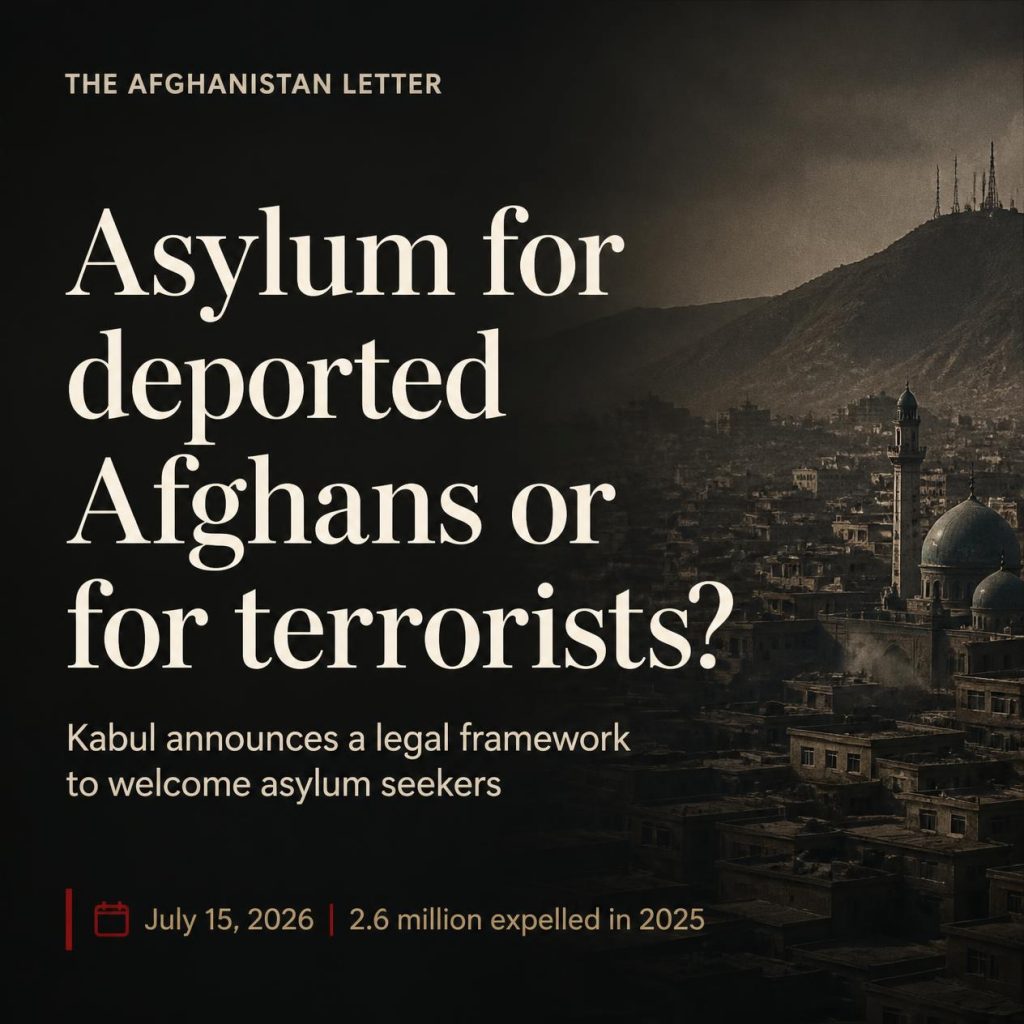
La Lettre d’Afghanistan
Asylum for Afghans Being Pushed Back, or for Terrorists?
Kabul announces a legal framework to receive asylum seekers. The question is who, exactly, the Emirate is seeking to protect.
On 15 July 2026, the Emirate’s Ministry of Refugees announced it had finalized a draft asylum law. The text is to be forwarded to the Ministry of Justice. No details have been made public. In a country from which more than two and a half million people were expelled in 2025 alone, the initiative warrants attention.
There is, first, the raw irony of the figures. Afghanistan remains one of the world’s leading refugee-producing countries. Since August 2021, millions of Afghans have fled to Iran, Pakistan, Europe, North America and Australia. In 2025, Iran and Pakistan alone forcibly returned more than 2.6 million people to the country, roughly 60 percent of them women and children. That the regime driving this exodus should equip itself with a law to receive asylum seekers is an inversion hard to read as anything other than a communication gesture aimed at foreign chancelleries.
The Deputy Minister of Refugees, Abdul Rahman Rashid, specified that the law would rest on Islamic and Sharia principles, and that a specialized committee had drafted the text. This reference to Sharia is not incidental. It defines in advance the pool of possible beneficiaries. An asylum law claiming universality protects anyone fleeing persecution. An asylum law indexed to the Taliban’s interpretation of Sharia protects those the Emirate deems worthy of it. The distinction is not rhetorical. It determines everything.
This is where the analysis must proceed with caution, but without naivety. Since the text of the law is unknown, no one can assert that it explicitly targets foreign fighters. But the context in which it appears licenses an uneasy reading. According to the annual report of the UN Sanctions Monitoring Team, published in December 2025, the Emirate is expanding its offer of sanctuary to terrorist groups with regional and international ambitions, continuing to allow Al-Qaeda and the TTP to operate on its soil. ETIM, aligned with Al-Qaeda, has hundreds of members there, active in Badakhshan, Faryab, Kabul and Nuristan.
As early as December 2024, representatives of the Turkestan Islamic Party discussed with the Taliban the transfer of Uyghur fighters from Syria to Afghanistan. The question of these men’s status therefore arises concretely. A legal framework for reception could, in practice, regularize a presence the Emirate had pledged to no longer tolerate. For in February 2020, in Doha, the Taliban had promised to prevent on their territory recruitment, training, financing and hosting, but also the abuse of asylum and the fraudulent use of travel documents. An asylum law read in light of that commitment becomes its exact reversal.
Institutionalizing what one swore to prevent: this may be the hidden meaning of a text presented as humanitarian.
This reading is a hypothesis, and it must be named as such. Nothing in the official statements confirms an intent of cover. But the Emirate has a documented practice of sanctuary, a precedent of a broken commitment, and a population of foreign fighters whose legal status remains murky. Taken together, these three elements are enough to justify vigilance.
Timing matters too. The announcement comes as diplomatic engagement with the Emirate intensifies. In June 2026, the European Union received a Taliban delegation in Brussels to discuss the return of rejected Afghan asylum seekers. Kabul seeks recognition, and knows that a veneer of the rule of law, a law here, a committee there, serves that ambition. An asylum law looks good in the file of a regime pleading its own normalization. It hands the capitals wishing to send Afghans back a convenient argument: since the Emirate legislates on asylum, it must have become a country to which one can return without risk.
That is precisely the reasoning that must be refused. A regime that bars girls from school beyond the age of twelve, that hunts down clandestine education networks, that persecutes former members of the national army, does not become a haven because it drafts a text on asylum. The law does not measure the reality it claims to govern. It measures what the regime wishes to display. And what it wishes to display, in this month of July 2026, is a state. Ours is to recall that behind the word, nothing has changed for those who flee.
✦ ✦ ✦